
Why a helicopter, when you can already see Na Pali from Tunnels
Stand on Tunnels Beach and look west and you’re already seeing a chunk of what every Kauai helicopter tour is built around: the eastern Na Pali ridge climbing toward Kalalau. Walk a few minutes further west into Hāʻena State Park and you can hike the Kalalau Trail’s first miles for the cliffs from on top. So why pay USD 280 to USD 450 for a 60-minute flight?
Because three-quarters of Kauai is gated. The inland Mt. Wai’ale’ale crater (one of the wettest spots on earth, ringed by 3,000-foot waterfalls), the Weeping Wall behind it, the inner sections of Waimea Canyon’s side gorges, and the back-of-Na-Pali valleys you cannot see from the ocean: those are aircraft-only. A standard 50-60 minute helicopter route from Lihue covers all of that plus the full Na Pali coastline plus Hanalei Bay in one loop. There is no boat tour, no kayak crossing, and no hike that gives you the same circuit.
That’s the value, and it’s why a Kauai helicopter tour is the single most-recommended activity that travelers who do one tour book.

Doors-on, doors-off, land-and-explore
Every Kauai helicopter tour leaves from Lihue Airport on the southeast coast (a few smaller operators run from Princeville on the north shore, but those are short-loop variants and skip the western canyons). The standard tour is 50 to 60 minutes and follows the same route in either direction: Lihue → Wailua Falls → Mt. Wai’ale’ale crater → Waimea Canyon → Na Pali → Hanalei → Lihue. Three formats sit on top of that route:
- Doors-on: standard A-Star or Eurocopter, glass-window flight. Quietest, most comfortable, shoulder belts and noise-cancelling headsets. Suitable for travelers nervous about flying. Roughly USD 280-380.
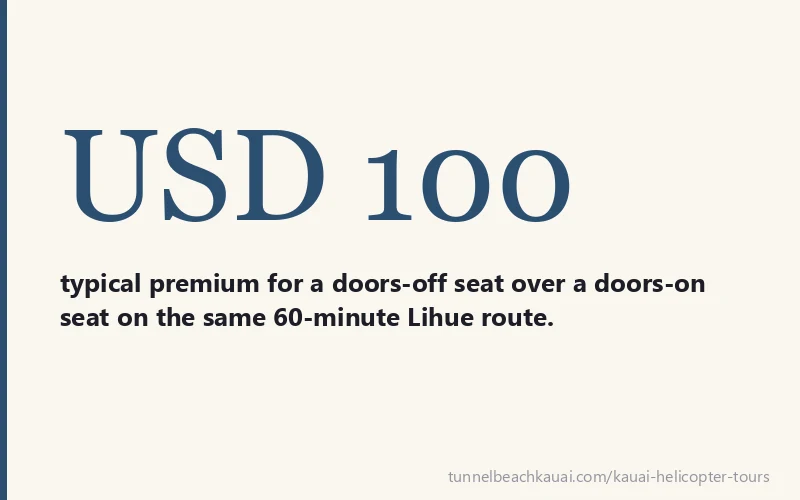
- Doors-off: usually Hughes 500 four-passenger helicopters with the doors removed. Photographers’ preference: no glass between the lens and the cliff, no reflections, full 180-degree field of view on each side. The wind is loud and constant; absolutely no loose clothing or accessories permitted (everything secured to the cabin). Roughly USD 350-450 and worth the premium for camera work.
- Land-and-explore: a small subset of operators have permitted land-on points inside Olokele Canyon (south of Waimea). These are 90-minute tours and run USD 400 to USD 550. The landing is the differentiator; the route up to the landing mirrors the standard.
A note on aircraft type: the Hughes 500 (smaller, four-passenger, doors-off) and the Airbus A-Star or Eurocopter (six-passenger, doors-on) handle Kauai weather differently. The A-Star is more stable in trade winds; the Hughes 500 is more maneuverable and gets closer to cliff faces. If you fly two helicopter tours on the same trip, fly different aircraft to feel the difference.
The “Eco Adventure” tour, explained
One product name comes up so often in searches that it deserves its own explanation: the Kauai Eco Adventure Helicopter Tour. It is not a landing tour and not a doors-off flight. It is a roughly 50-minute doors-on circuit flown in the Eco-Star, an aircraft built for sightseeing: wraparound panoramic glass, theater-style raised rear seats, and a tail design that cuts noise roughly in half compared with the standard fleet (the quieter footprint over the valleys is where the “eco” branding comes from).
The route is the full signature circuit: Manawaiopuna Falls (the “Jurassic Park” falls, visible only from the air), Olokele and Waimea Canyons, the Na Pali cliffs, Hanalei Bay, and the Mt. Wai’ale’ale crater when weather allows. In our tour list it runs about USD 450, which prices it at the top of the doors-on tier. The way to think about it: it is the comfort-and-visibility pick, the best doors-on option for travelers who want maximum glass without the wind and noise of a doors-off Hughes 500. Photographers who want lens-out-the-door shooting should still book doors-off; everyone else gets the bigger windows here.

The morning-flight weather rule
Kauai’s helicopter weather is best in the first window of the day. Trade winds typically build from late morning into mid-afternoon, and trade winds above about 25 knots scrub flights or restrict them to the leeward (south) side, cutting Na Pali out of the route. Cloud cover over Mt. Wai’ale’ale also tends to thicken through the day; a 7 AM departure regularly clears the crater rim, while a 1 PM departure sees only the inside of a cloud.
Operators sell morning slots first because they know this. Book early. If your trip has only one weather-dependent helicopter day, schedule it for the first or second day on the island so you have a reschedule buffer if the morning gets cancelled.
A separate-but-related point: helicopters are grounded at lower wind thresholds than boats. If the trade-wind forecast is borderline (20-30 knots), the boats often still sail Na Pali while the helicopter operators stand down. Some travelers split their pair of tours specifically for this reason, with the helicopter on the calmer day.
Camera kit, motion sickness, kids
Camera kit (doors-off only): bring one camera body. Two lens swaps mid-flight are a recipe for losing equipment. The standard kit is one mirrorless or DSLR with a 24-105mm or 16-35mm zoom, secured to your wrist with a hand strap, secured to your harness with a tether. No extra lenses in your lap. No GoPro on a stick (operators ban most extension poles). Phone cameras are allowed but the wrist tether is mandatory. Bring lens-cleaning cloth: ocean spray on the cliff approach is real.
Motion sickness: helicopter flight has negligible motion sickness risk for most passengers. The exception is the doors-off model on a windy day, which can induce mild ear pressure or vertigo if you sit on the upwind side. If you are sensitive, take Bonine 30 minutes before boarding (Bonine is non-drowsy; Dramamine is the drowsy alternative) and request a leeward seat at check-in.
Kids: helicopter tours typically allow children 2 and up but charge full adult fare for any seat occupant. There are no infant seats; no lap-held babies are permitted on any operator. The minimum age for doors-off varies by operator but is usually 8 to 10. Booster seats are not provided; tall-enough kids who fit the standard seatbelt are fine, smaller kids may struggle with the shoulder belt.
How weight and seat placement actually work
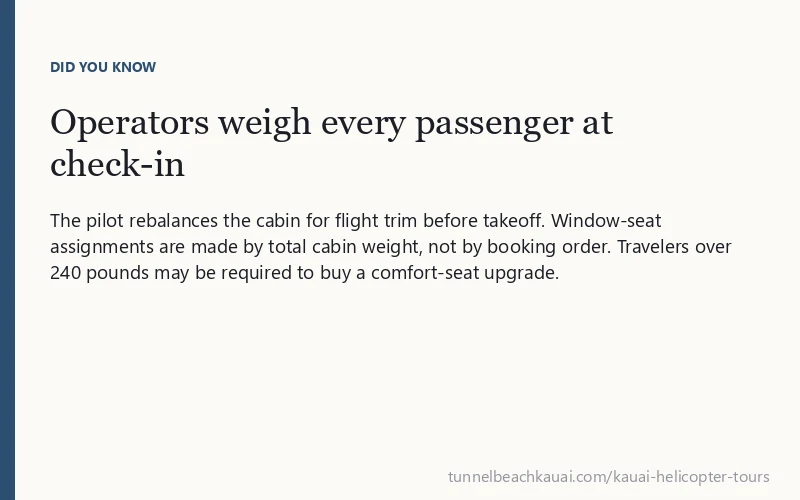
Operators weigh every passenger at check-in and rebalance the cabin for trim. This is not optional and not negotiable. If you are over 240 pounds, some operators will require purchasing a “comfort seat” upgrade (an empty adjacent seat, roughly 1.5x base fare). This is published on each operator’s site but easy to miss until check-in.
Seat placement on the standard A-Star is determined by total cabin weight, not by purchase order. The pilot may seat you in the middle row if the trim demands it, even if you booked first. The middle row has narrower windows. Doors-off Hughes 500 has only four seats and the cabin is almost square, so seating is more about photography preference (left vs right side of the route).
How to choose
| Goal | Pick | Why |
|---|---|---|
| Best photo trip | Doors-off Hughes 500, morning slot | No glass, no reflections, calm air. |
| Best comfort | Doors-on A-Star, mid-morning | Quiet, climate-controlled, six seats. |
| Once-in-a-trip experience | Doors-off + Olokele land tour | The only chance to set foot inside the canyon. |
| Cheapest viable circuit | Doors-on, mid-morning, partly cloudy | Operators discount the cloudier slots. |
| Pair with a boat tour | Helicopter day 1, Na Pali boat day 2 | Inland + cliffs in two perspectives. |
If you only do one tour on the island: doors-off helicopter, morning slot, with a buffer day in your itinerary in case the first morning gets cancelled. If you have two days: pair it with a Na Pali Coast catamaran or zodiac for the same coastline from sea level. The two perspectives don’t overlap.
How we picked these tours
We started with every Kauai helicopter tour we could find and kept those whose routes actually cover the standard Lihue circuit. Inside each launch point, the running order is roughly what locals would tell you to book first: tours that consistently sell out, operators with hundreds of recent reviews and 4.8-plus ratings, and the ones with free cancellation so a windy day doesn’t cost you the booking. Doors-on, doors-off, and land-and-explore options sit alongside each other so you can compare without scrolling past either.
You can also open the interactive Kauai map and type “helicopter” in the search to see how these tours compare against the rest of the island.